Islamic homeschooling FAQ

This Islamic homeschooling FAQ answers the questions parents ask us most: how much time Feetra takes, whether it works with children of different ages or with a full-time job, where the ayat and hadith come from, how screens are used, and how the free pilot works. If your question is not here, ask us through the pilot form and we will add it.


Islamic homeschooling FAQ: a cup of tea beside an open notebook with handwritten questions

Islamic homeschooling FAQ: about Feetra

The basics: what Feetra is, who it is for, and how it is different.

A small potted plant growing beside a mushaf on a windowsill
Q

What is Feetra Academy?

A family Islamic homeschool portal from Malaysia. It helps parents raise children upon the Qur’an and the way of Rasulullah ﷺ and his companions, with a parent track and a weekly family lesson. Content is in BM and English.

Q

Do I need to homeschool full time?

No. Feetra works alongside school or full homeschooling. Many families use it after Subuh, after Maghrib and at the weekend. It is a family layer of Qur’an and character, not a replacement for every school subject.

Q

Is Feetra in BM or English?

Both. The Malay edition keeps the same acronyms and uses Malay terms throughout: Akar, Tunas, Dahan and Buah for the stages, and Alam, Persekitaran, Semasa and Sirah for the four classrooms.

Q

How is it different from a Qur'an class?

A class teaches the child. Feetra teaches the parent to teach, because children copy what they see. Our Quran parenting method starts from a sign of Allah, meets the ayah, and turns it into one deed the family lives that week.

Ibn Majah 61

Time, rhythm and working parents

This part of the Islamic homeschooling FAQ is for busy families. The day is anchored to prayer times, not the clock. Both rhythms cover the same SEEDS lesson; they differ only in when and how long.

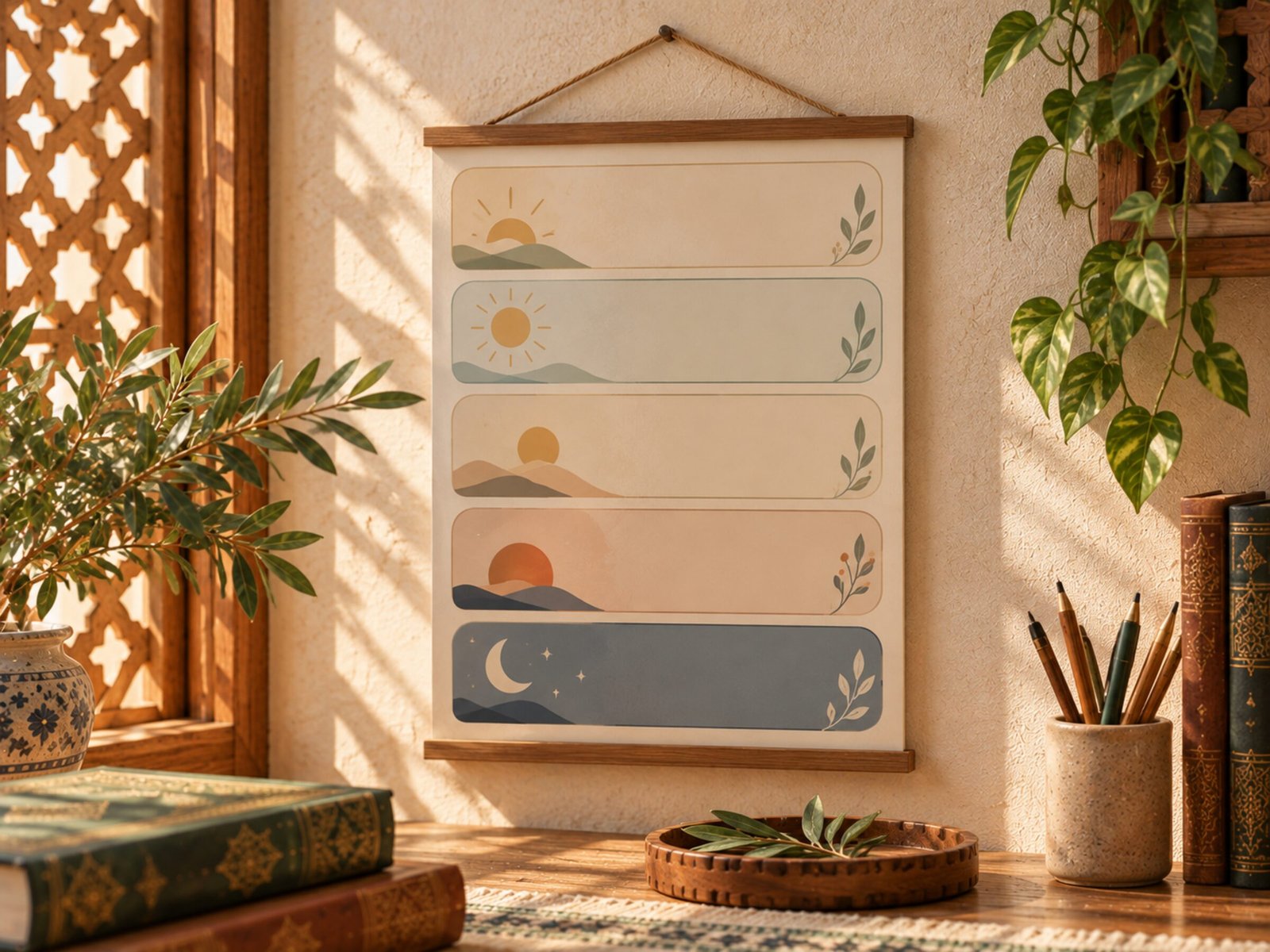
A simple wall planner divided by the five prayer times
Q

How much time does it take?

The working-parent rhythm is about one hour a weekday in short pieces, plus 90 minutes at the weekend. The stay-at-home rhythm is about two hours a weekday. The parent track is about 15 minutes a week.

Q

I work full time. Can I still do it?

Yes. There is a rhythm made for you: the ayah of the day after Subuh, a task card left with the carer or an older sibling, the lesson after Maghrib, Bedtime Seerah after Isha, and the LIGHT circle at the weekend.

Q

What if we miss a week?

A missed week carries over. Nothing is marked as failed, and there are no streaks to break.

Islamic homeschooling FAQ: ages and siblings

Feetra is built for families, so siblings of different ages learn the same theme together.

Three pairs of small shoes lined up at a doorway, from toddler to older child
Q

What ages is Feetra for?

From age 3. The four growth stages are Root (3–6), Sprout (7–9), Sapling (10–12) and Fruit (13+). Fruit is also the aim at every age.

Q

I have children of different ages. How does that work?

Every child follows the same weekly theme. What each child does depends on their stage: a Root child draws a bee and says its name, a Sapling child finds other ayat that end with a call to think. Older children help younger ones, which is the Witness level of GROW.

An-Nahl 16:68–69

Q

Are children tested or compared?

Never compared. GROW checks are private to the family and look at understanding and practice. At the Root stage nothing is tested by recall, and there are no points, prizes or leaderboards for acts of worship.

Bukhari 2587

Sources, scholars and differences

Parents rightly want to know where the content comes from, so this is the most important part of the Islamic homeschooling FAQ.

Q

Where do the ayat and hadith come from?

The Qur’an, and hadith graded sahih or hasan. No weak hadith for duas or acts of worship, and never anything fabricated. Each card shows the source with book and number, the grading and who graded it.

Q

Who checks the content?

Each area has an advisor: tadabbur, seerah, hadith, and tajwid. Nothing is published until that advisor signs it off. Meet them on the Islamic education advisors page.

Q

Can I check a hadith myself?

Yes, and we encourage it. Every card shows the collection and number, and all references are checked against sunnah.com or dorar.net before publication.

Q

Which madhhab do you follow?

Where scholars differ with evidence, Feetra teaches the position set by our hadith advisor and shows its evidence, and children learn with adab that others follow other evidence. Where the Shafi’i school holds a view, such as qunut at Subuh, we say so.

Bukhari 946

Screens, print and audio

Screens are the top worry in any Islamic homeschooling FAQ. Print carries the hands-on work with the child. Digital carries planning, tracking and correct pronunciation.

Printed dua cards on a ring beside a small speaker
Q

How much screen time is there?

Very little for the child. Digital puzzles use the week’s words and ayat for about 15 minutes, done together. Screens go off in the hour before sleep.

Al-Isra 17:36

Q

Is there music?

No. The audio library is Qur’an recitation and duas recited by Khalif Murtaza Khan and checked by Ustaz Muhammad Faiz (Abu Mujahid).

Q

Can I print the materials?

Yes. Every printed item is also a downloadable PDF, and a printed kit per term is planned.

Islamic homeschooling FAQ: the pilot and pricing

The questions families ask before they join.

Q

Is the pilot really free?

Yes. Pilot families use Feetra free during the pilot. We will confirm what stays free after the pilot before it ends, so nobody is surprised.

Q

When does it start and how many families?

The pilot begins on 4 January 2027 with 15 to 20 families, starting with Term 1, Nature. Pilot families can log in as soon as we pre-launch.

Q

What happens after the pilot?

Feetra will move to subscriptions by module or as a package. Pricing is still being decided, and pilot families will hear first. Read the full details on the free pilot page.

Still have a question?

Register for the pilot and write your question in the form, and we will add it to this Islamic homeschooling FAQ. You can also read the full syllabus first.

Scroll to Top